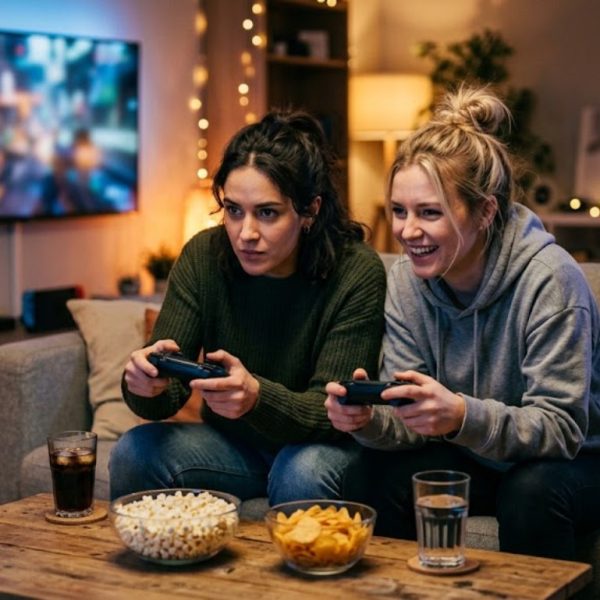
Online lobbies solved a lot of problems, but they quietly took something away. When your teammate is a voice in a headset three time zones off, you never get the elbow in the ribs, the groan when somebody grabs the last health pack, or the argument about who was supposed to be holding the torch. That is why the best couch co op games have refused to disappear. They are the last corner of the hobby where two or four people sit in the same room, stare at the same screen, and blame each other out loud.
We see it play out most weekends. A group books a console for a couple of hours planning to settle some score in a fighting game, and twenty minutes in they have quietly switched to something cooperative, because shouting at a shared problem turns out to be better company than shouting at each other. Cooperative play is almost as old as the home console itself, and the modern version has grown far more ambitious than the two player arcade runs it came from.
Start with something that teaches itself in ninety seconds
The fastest way to kill a shared session is a game that needs a tutorial longer than the attention span in the room. Overcooked 2 still works because the rules are visible from across the sofa: chop, cook, plate, repeat, while the kitchen actively tries to ruin your life. Moving Out applies the same trick to furniture, and its assist mode lets a complete newcomer keep up without anybody feeling patronised.
Games like these matter because they flatten the skill gap. A seasoned player and somebody who has not held a controller since the PlayStation 2 can be equally useless at carrying a sofa through a doorway, and that shared incompetence is the entire point. Nobody is spectating, nobody is being carried, and the first round of laughter usually arrives inside two minutes.
When you want a story and not just a scoreboard
It Takes Two remains the strongest argument that cooperative design can carry a full campaign. It cannot be played alone, every chapter invents a new mechanic before the last one gets stale, and it hands each player a different toolset so neither can drift into passenger mode. Hazelight pushed the same idea further with Split Fiction. A Way Out, older and rougher around the edges, still delivers one of the sharpest endings the genre has produced.
These are longer commitments, usually eight to twelve hours, so they suit a pair who will come back rather than a rotating group of six. Plan two or three sittings instead of one marathon, and agree in advance who is playing which half. Swapping roles halfway through a campaign rarely goes well.
Split screen ps5 games that still reward real skill
Not everyone wants a game about cooperation and feelings. Rocket League is still the cleanest four player split screen on the console, the rules take eight seconds to explain, and nobody has ever really mastered it. Gran Turismo 7 handles a two player split beautifully on a large panel. Teenage Mutant Ninja Turtles: Shredder's Revenge runs six players through a beat em up that is unapologetically nostalgic, and Borderlands 3 gives two players a loot campaign with enough noise and colour to fill a whole evening.
Couch co op games are best enjoyed with friends who do not all hear the same things in the same way. The studios getting this right invest in video subtitling services so that party chatter never hides a plot point. Accessibility in shared play is simply good design.
If the group is arguing about what to load next, the recommendation threads in the r/CoOpGaming community are unusually good at separating games that genuinely support local play from the ones that only advertise it. Publishers have a habit of quietly dropping split screen after launch, and players notice long before the store pages are updated.
The room decides more than the roster does
A great lineup on a poor screen is still a poor evening. Split screen halves your vertical space, so text that reads fine in single player becomes awkward at two players and hopeless at four. Panel size, refresh rate and input lag all change how a shared session feels, which is why it pays to understand how to choose a gaming monitor before spending money on one for the living room. Seating distance matters just as much. Two people sharing a sofa need roughly a third more screen than one player sitting alone at the same distance.
Language is not a footnote
Mixed groups run into this constantly. One person reads the subtitles comfortably and another does not, and the pace of the whole session drops to match the slowest reader. Studios have become much better at shipping full localisations on day one, partly because the commercial case is settled. Research into why consumers buy in their native language shows that people spend more time and more money on products they can read without effort, and games are no exception. Five minutes in the console settings before a group session, checking that the interface language suits everybody rather than just whoever owns the account, saves a lot of quiet frustration later.
How to run the evening
Three or four titles is plenty. Open with something chaotic and short to get everyone laughing, move into the longer cooperative campaign while concentration is at its highest, and keep one competitive game in reserve for the final half hour when people are tired and want something simple. Set up controllers and profiles before anyone arrives, because ten minutes of pairing pads and headsets at the start drains a room faster than any losing streak.
The best couch co op games are not really about the games at all. They are about the fact that nobody can mute you, nobody can leave the lobby, and the person who ruined the run is sitting right there, reaching for the crisps.